
Last updated October 16, 2026
 Water damage drying
 Fire & smoke cleanup
 Mold remediation
 Storm response
 Sewage cleanup
 Reconstruction
Free visual inspection and a written scope of work before any mitigation begins - photos, moisture readings, and drying logs go in your claim file
The scope we write is the scope we bill. Anything new gets shown to you, in writing, before we touch it.
Get your free estimateDamage Restoration Cost Breakdown: The Orange County Homeowner’s Reference for 2026
An LGR dehumidifier rents for about $80 a day. Restoration companies routinely bill $120 to $180 a day to run one in your house. That markup is legitimate when a technician is on site daily, checking moisture readings and adjusting equipment placement. It’s not legitimate when the machine sits untouched for a week while the meter keeps running. Most Orange County homeowners only learn which scenario they paid for after the invoice arrives. This guide breaks down every line item on a typical water damage restoration bill, gives you current 2026 price ranges for Orange County specifically, and shows you how to read a contract so the final number matches the number you approved.
Quick Answer
Water damage restoration in Orange County costs between $2,500 and $8,500 for a typical single-room incident in 2026, with most jobs landing around $4,200. Costs rise with affected square footage, water category (clean vs. contaminated), and how long water sat before extraction began. The single biggest variable is the contract type: a written not-to-exceed estimate protects your wallet, while a time-and-materials authorization can double the final bill without any additional approval from you.
Restoration work we handle
Table of Contents
- The Line-Item Breakdown: What You’re Actually Paying For
- How Xactimate Pricing Works (and How Contractors Use It Against You)
- Three Cost Factors Unique to Orange County
- Written Not-to-Exceed vs. Time-and-Materials: The Contract Language That Matters
- 2026 Average Costs by Job Type
- How Insurance Interacts With Your Restoration Bill
- Common Mistakes to Avoid
- When to Call a Professional
- Frequently Asked Questions
The Line-Item Breakdown: What You’re Actually Paying For
Every restoration invoice uses the same basic categories, whether you’re in Anaheim or Laguna Niguel. Knowing what each line means before you sign is the difference between an informed decision and a blank check. Here is a typical Orange County water damage invoice, line by line, with 2026 market ranges.
Emergency Service Call: $150 to $350
This covers the dispatch, travel, and the first hour of assessment. Some companies waive this if you proceed with restoration. Others charge it regardless. Ask before the technician arrives. At Wendell Restoration Orange County home, we put the service call fee in writing before dispatch, and it’s credited toward the job if we do the work.
Moisture Mapping and Assessment: $200 to $500
Technicians use thermal imaging cameras and penetrating moisture meters to map where water traveled. This is the diagnostic phase, and it matters more than any other line item. Water hides behind baseboards, under tile, and inside wall cavities. A thorough map catches secondary damage before it becomes structural. In Orange County slab foundation homes, which dominate the housing stock built from 1950 through 1985, water often travels under flooring and into wall plates where it is invisible from the surface.
Water Extraction: $500 to $2,000
Standing water removal using truck-mounted or portable extraction units. On a typical 200-square-foot affected area with half-inch standing water, expect $500 to $900. On a 600-square-foot flooded basement or slab, $1,200 to $2,000. Extraction pricing scales with water volume and how difficult the water is to reach.
Equipment Placement (Daily): $25 to $55 per day per unit
Here is where the invoice gets complicated. Most jobs require multiple pieces of equipment:
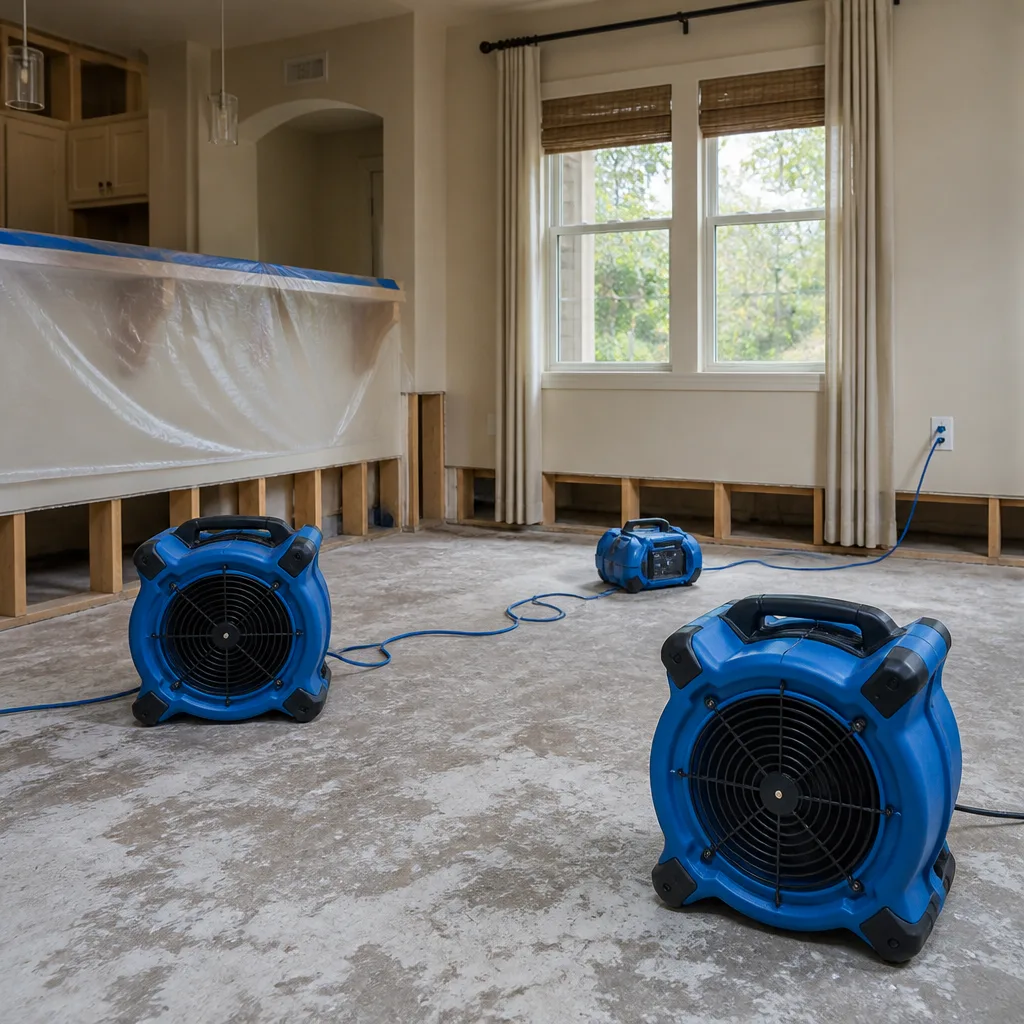
- Air movers: $25 to $35 per day each. A standard room needs 4 to 8. High-velocity fans accelerate surface evaporation.
- LGR dehumidifiers: $75 to $180 per day each, depending on capacity. LGR stands for Low Grain Refrigerant, and these machines pull moisture from the air so walls and floors can release trapped water. This is the line item where overbilling hides most easily.
- HEPA air scrubbers: $60 to $120 per day each. These filter airborne particulates and are mandatory on Category 3 (contaminated) jobs.
- Injectidry drying systems: $150 to $250 per day. These force air into wall cavities and under cabinets where surface drying cannot reach. We use Injectidry equipment when water has wicked up drywall or behind built-ins, a common situation in Orange County kitchens with particleboard cabinet bases.
A 3-day dry-out on a standard bathroom supply line burst, using 6 air movers, 2 LGR dehumidifiers, and 1 air scrubber, should run about $1,300 to $1,800 in equipment charges total. If your invoice shows 10 or 12 air movers for a single bathroom, question it. More equipment does not always mean faster drying, and a company being paid per unit per day has an incentive to over-place.
Daily Monitoring: $50 to $125 per visit
This is the line item most homeowners skip right past, and it is the one that separates professional restoration from equipment rental. A technician should visit daily, take psychrometric readings (tracking the air’s moisture level so we know when your home is truly dry, not just surface-dry), log the data, and adjust equipment as drying progress indicates. If the company is not doing this, you are paying professional equipment prices for what is effectively a DIY rental. Ask to see the drying log.
Antimicrobial Treatment: $150 to $450
After extraction and during drying, technicians apply EPA-registered antimicrobial products to affected surfaces to prevent mold growth. On Category 2 (grey water) and Category 3 (black water) jobs, this is non-negotiable. On clean water jobs where drying happens quickly, some companies will still charge for it. It is a judgment call, and a good company will explain whether your situation warrants it.
Containment and Demolition: $300 to $2,500
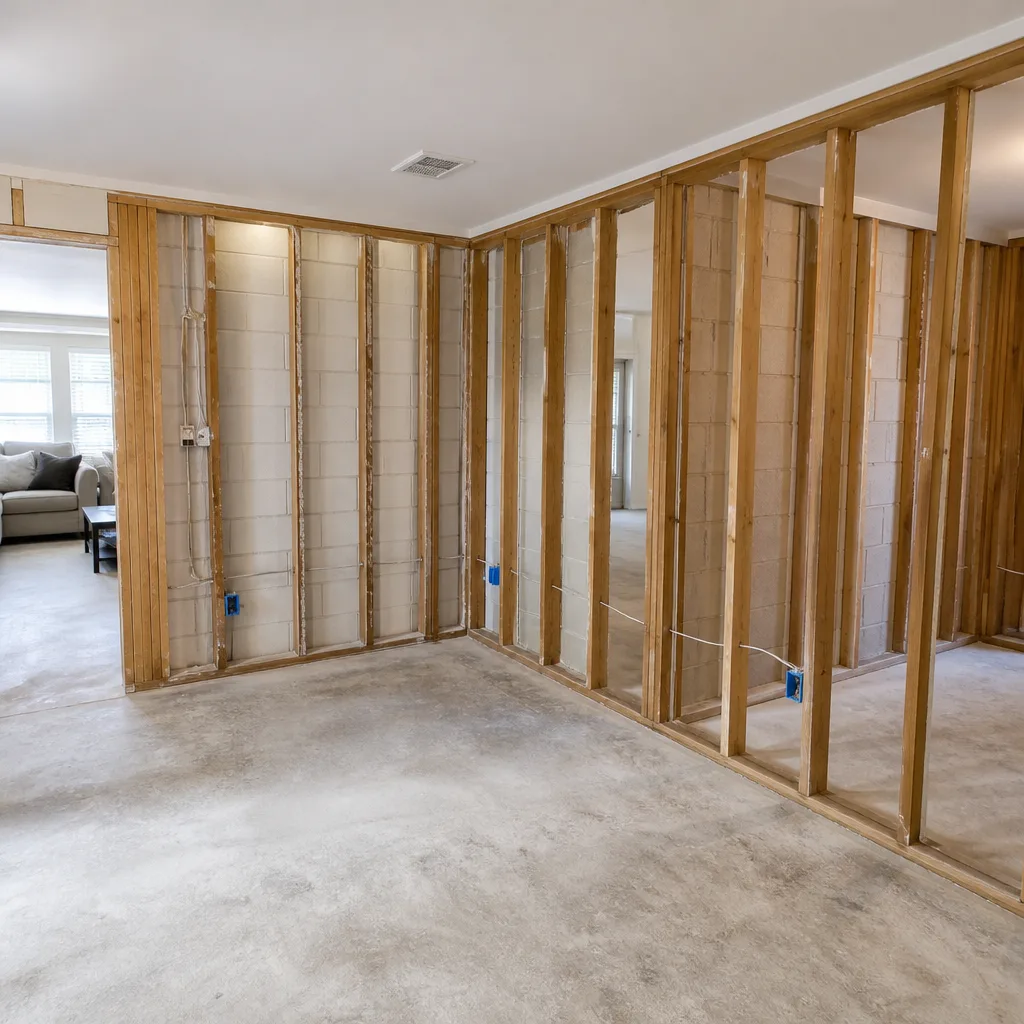
When drywall, baseboards, or flooring must be removed, you will see containment (plastic barriers to isolate the work area and prevent cross-contamination) plus demolition and debris hauling. In Orange County, disposal costs at landfills run higher than inland counties, which pushes this line item up compared to Riverside or San Bernardino. A standard drywall cut of 2 feet around a flooded bathroom runs $500 to $900. Full flooring removal in a flooded kitchen can hit $2,000 or more.
How Xactimate Pricing Works (and How Contractors Use It Against You)
Xactimate is the estimating software used by most insurance carriers and restoration contractors. It indexes local material and labor costs by zip code, then generates line-item pricing that both sides treat as a neutral baseline. Here is what nobody tells you: Xactimate is a negotiation tool, not a rulebook. Contractors who work regularly with insurance companies know how to manipulate it.
Category 1, 2, and 3 Water: The Classification That Changes Everything
- Category 1 (Clean Water): Water from a broken supply line, faucet, or water heater. Lowest treatment threshold. Basic extraction, drying, and antimicrobial application. The most affordable claims to restore.
- Category 2 (Grey Water): Water with some contamination, such as dishwasher overflow, washing machine discharge, or aquarium leaks. Requires antimicrobial treatment, more aggressive drying, and often carpet pad replacement.
- Category 3 (Black Water): Sewage, flood water, or any water containing pathogens. Requires full containment, HEPA air scrubbing, disposal of affected carpet and pad, and sometimes wall removal. Costs 2 to 3 times more than Category 1 work on the same square footage.
The classification should be made by a certified technician based on the water source, not on how bad the damage looks. Water Damage Restoration in Orange County companies follow IICRC standards for classification, and you have the right to ask why a specific category was assigned before you sign anything.
Spotting Upcoding on Your Estimate
Upcoding is when a contractor applies higher pricing than the work performed justifies. Common examples: billing Category 2 rates on a clean supply line break, charging for 3 dehumidifiers when 2 were on site, listing daily monitoring visits that never happened, or billing for demolition that was not performed. The fix is simple: a detailed photo log, which a professional company provides by text as standard practice, and a written scope agreed before work starts. If the company cannot or will not provide either, walk away.
Three Cost Factors Unique to Orange County
Orange County is not the same market as Los Angeles County or San Diego County. Three things push restoration costs here specifically.
1. Labor Rates 18 – 22% Above the California Average
OC restoration technicians command higher wages, driven by the cost of living and competition for skilled labor. The result is a labor rate of roughly $75 to $110 per hour for certified techs, compared to $60 to $85 statewide. On a 40-hour restoration job, that adds $600 to $1,000 to the invoice. You are not being overcharged. You are paying for technicians who can afford to live within driving distance of your house.
2. Disposal Fees at OC Landfills vs. Inland Counties
Debris from demolition must go somewhere, and Orange County landfills charge more than Riverside or San Bernardino. A trailer load of water-damaged drywall and carpet that costs $85 to dump in Moreno Valley runs $150 to $220 at OC facilities. Contractors pass this through as a line item, and it is legitimate. What is not legitimate is seeing an inland disposal rate on an Orange County invoice, or a disposal fee on a job where no demolition occurred.
3. Permit Costs That Vary by City
Most emergency water damage restoration does not require a permit. But if structural repairs follow, such as subfloor replacement or wall reconstruction, permits come into play. Permit fees in Irvine, Newport Beach, and Huntington Beach run higher than in Santa Ana or Garden Grove. If your restoration leads to reconstruction, which then becomes Water Damage Repair in Orange County, your contractor should tell you upfront whether permits are required and what they will cost.
Written Not-to-Exceed vs. Time-and-Materials: The Contract Language That Matters
Here is the truth about restoration billing: the contract type matters more than the square footage. Two identical water damage jobs in Costa Mesa can produce a $3,800 bill and a $9,200 bill based solely on how the authorization form is worded.
Time-and-Materials Authorization
This is a blank check. You are authorizing the company to perform work and bill you based on the hours spent and equipment placed, at rates shown on a rate card you probably did not read. The rates themselves are usually fair. The problem is that the system incentivizes slower work and more equipment. Two dehumidifiers dry a room in 5 days. Three dehumidifiers might dry the same room in 4 days, but they cost 50% more per day. A time-and-materials contractor chooses three.
Written Not-to-Exceed Estimate
This is the protection every Orange County homeowner should insist on before signing. It states: here is the work we will perform, here is the equipment we will place, here is the daily monitoring we will do, and here is the maximum amount you will pay. The company can come in under that number, but never over it without written approval from you. If a contractor will not provide a not-to-exceed estimate, that is information. We have built our Orange County operation on written, not-to-exceed pricing because the homeowners we serve, people in their 30s and 40s who expect to track a service like a rideshare, have zero tolerance for a number that changes at the door.
The Specific Language to Ask For
- “Total project cost will not exceed $[amount] without written approval from the homeowner.”
- “Daily monitoring visits are included in the total and will be documented with photographs and moisture readings.”
- “Equipment quantities and types are specified in Attachment A and will not be modified without written approval.”
- “A written guarantee covering workmanship for 365 days is included at no additional charge.”
If a company is unwilling to put those sentences in writing, you are about to be billed on their schedule, not your approval.
2026 Average Costs by Job Type
Here are the numbers Orange County homeowners keep asking us to clarify. These are total project costs, including extraction, drying, antimicrobial treatment, and monitoring. They reflect 2026 OC market pricing and assume a written not-to-exceed estimate, not a time-and-materials authorization.
Bathroom Supply Line Burst: $2,800 to $5,500
Most common call we get. A braided supply line fails under the sink while you are at work. Water pools on the floor, wicks up the vanity, and runs into the hallway. Affected area is usually 80 to 250 square feet. Low end: caught within 2 hours, tile floor, minimal wicking. High end: water sat overnight, carpet in adjacent hall, baseboard and drywall replacement included.
Dishwasher Overflow: $1,800 to $4,200
Category 2 water, which means antimicrobial treatment is mandatory and carpet pad replacement is likely if water reached a carpeted area. Kitchen jobs often involve cabinet damage, and particleboard cabinets in older OC homes will swell and delaminate within 24 hours. The cost to dry behind and under cabinets with Injectidry drying systems is factored into the mid and high ranges.
Roof Intrusion After Rain: $3,500 to $9,000
Orange County does not get a lot of rain, but when it rains, it rains hard, and older roofing fails. Water comes through the ceiling, soaks insulation, and spreads across the attic. Insulation replacement alone runs $1,500 to $3,000 depending on square footage. Add drywall ceiling repair, painting, and the restoration dry-out, and you land in the mid-to-high range quickly. November through March is when we see these calls spike.
Slab Leak Under the Foundation: $6,000 to $15,000+
The most expensive residential water damage scenario in Orange County, and the one that most often involves a full home repipe in addition to restoration. Water from a leaking pipe under a concrete slab travels upward through the slab, saturating flooring and wicking into walls. The restoration component includes flooring removal, slab drying (which takes longer than above-grade drying), and sometimes wall drying. The plumber is a separate bill. If the slab leak is in a newer OC tract home, the leak may be in PEX lines, which is a plumbing issue but not a restoration cost driver. If it is in a 1960s or 1970s home with copper, expect a larger restoration footprint.
For a broader look at how restoration fits into the repair landscape, our water damage repair guide covers the reconstruction phase that follows dry-out.
How Insurance Interacts With Your Restoration Bill
Insurance is in the room on almost every restoration, even when you think it is not. Sudden water damage from a burst pipe or appliance failure is typically covered by homeowner policies. Mold remediation is often excluded or capped, especially if the source of water was not addressed promptly. Here is what matters for your bill.
Your insurer will send an adjuster who uses Xactimate to estimate the restoration cost. The contractor you choose has the right to negotiate with the adjuster, and a restoration company that knows how to work with carriers will submit photo documentation, daily drying logs, and a detailed scope that justifies each line item. Mold Remediation in Orange County has its own insurance dynamics, because carriers treat mold claims differently than water claims, and a company that understands the distinction will tell you before work starts whether your mold problem is likely to be covered.
The practical advice: do not sign a restoration contract that says you are personally responsible for any amount the insurance company does not cover, unless you understand exactly what that gap could be. Ask the contractor to bill your carrier directly and to provide photo documentation of all work. A company that sends before-and-after photos by text does this as standard practice, and you will have an evidence trail if the adjuster questions anything.
Common Mistakes to Avoid
- Waiting to call because you want to see if it dries on its own. Warm Orange County air accelerates mold growth. Within 48 to 72 hours, a Category 1 water event becomes a mold problem. The restoration cost rises, and your insurance coverage may not follow.
- Signing a time-and-materials authorization without a not-to-exceed cap. This is the single most expensive signature you will ever put on paper. Ask for a written cap before work starts. If the answer is no, call someone else.
- Choosing a contractor based on who the insurance company recommends. The carrier’s preferred vendor list is built around the carrier’s cost containment, not your outcome. You have the right to choose any licensed restoration company.
- Not asking about equipment placement before the crew arrives. A company that places 10 air movers in a 100-square-foot bathroom is either incompetent or maximizing daily equipment billing. Either way, you should ask for a written equipment list before placement.
- Ignoring the drying log. If a company cannot show you moisture readings that decline day over day, the drying is not working and the meter is still running. Insist on the log.
- Paying the full invoice before the work is complete. A written guarantee, like our 365-Day Done Right Promise, is your leverage. Do not release the final payment until the work is finished and you have the guarantee in writing.
- Assuming all water damage is the same. Category 1, 2, and 3 water require different protocols. A company that treats a sewage backup with the same checklist as a supply line break is cutting costs on your health. IICRC classification exists for a reason.
When to Call a Professional
Water damage restoration is not a DIY project, but homeowners sometimes rationalize renting fans from a big-box store to save the service call. That works in exactly one scenario: a clean water spill caught within minutes, on a non-porous floor, with no wall or cabinet contact. Every other situation, water that ran overnight, water that wetted drywall or carpet, water from any source other than a clean supply line, or water you can smell, warrants professional extraction and drying. The risk of skipping it is mold in the wall cavity, subfloor rot, and a repair bill three times the restoration cost. Wendell Restoration Orange County offers free estimates in Orange County. Call (350) 207-2599 and a live person answers, 24/7, not a voicemail tree.
Frequently Asked Questions
Most Orange County water damage restoration jobs cost between $2,500 and $8,500, with the average single-room incident landing around $4,200. Factors that move the number include affected square footage, water category, how long water sat before extraction, and whether the contract is not-to-exceed or time-and-materials. Call (350) 207-2599 for an exact quote on your situation; estimates are free.
Sudden and accidental water damage from a burst pipe, supply line failure, or appliance malfunction is typically covered by standard homeowners policies. Gradual leaks, neglect, and most mold claims are often excluded or capped. A restoration company that provides photo documentation and daily drying logs gives your adjuster the evidence needed to approve the full scope. Contact us and we will help you understand what your policy likely covers.
A professional restoration company with 24/7 live-answer dispatch can have a technician on site within 60 to 90 minutes anywhere in Orange County, from Fullerton to San Clemente. Water damage does not keep business hours, and the companies that treat it as an emergency are the ones that prevent secondary damage. We answer calls live around the clock at (350) 207-2599 and send a background-checked, uniformed technician with a live arrival time you can track.
Category 1 is clean water from a supply line or faucet, Category 2 is grey water with some contamination from sources like dishwashers or washing machines, and Category 3 is black water from sewage or flood sources that carries pathogens. The category determines the treatment protocol and the cost, with Category 3 jobs running 2 to 3 times more than Category 1 work on the same square footage. Classification should follow IICRC standards and be explained to you in writing before work begins.
If water touched drywall, carpet, cabinets, or baseboards, or if it sat for more than a couple of hours, professional extraction and drying is the difference between a $3,000 restoration and a $12,000 mold remediation plus structural repair. Surface drying does not address water trapped in wall cavities or under flooring. A moisture mapping assessment tells you exactly how far the water traveled. We offer free assessments across Orange County.
A restoration company that works regularly with insurance carriers should handle the adjuster communication for you, providing the documentation, photos, and drying logs the adjuster needs to approve the scope. You should not be the one translating between the contractor and the carrier. Ask before hiring whether the company bills insurance directly and how they handle adjuster negotiations. It should be part of the written scope, not an afterthought.
The Bottom Line
Orange County water damage restoration costs are predictable when you know what drives them: square footage affected, water category, equipment placement, and most importantly, the contract you sign. A written not-to-exceed estimate from a company that documents its work daily protects you from the industry’s structural incentive to over-bill. The line items on your invoice are not secrets. Emergency service, moisture mapping, extraction, equipment, monitoring, antimicrobials, and containment all have market rates, and now you know them. The next step is a phone call, and the only question left is whether the person who answers gives you a price in writing before any tools come out. Call (350) 207-2599 for a free estimate from a live person, 24/7.
Written by Blake Sorensen, Owner at Wendell Restoration Orange County, serving Orange County since 2006.
See the difference
 Before
 After
After Before
 After
After Before
 After
After